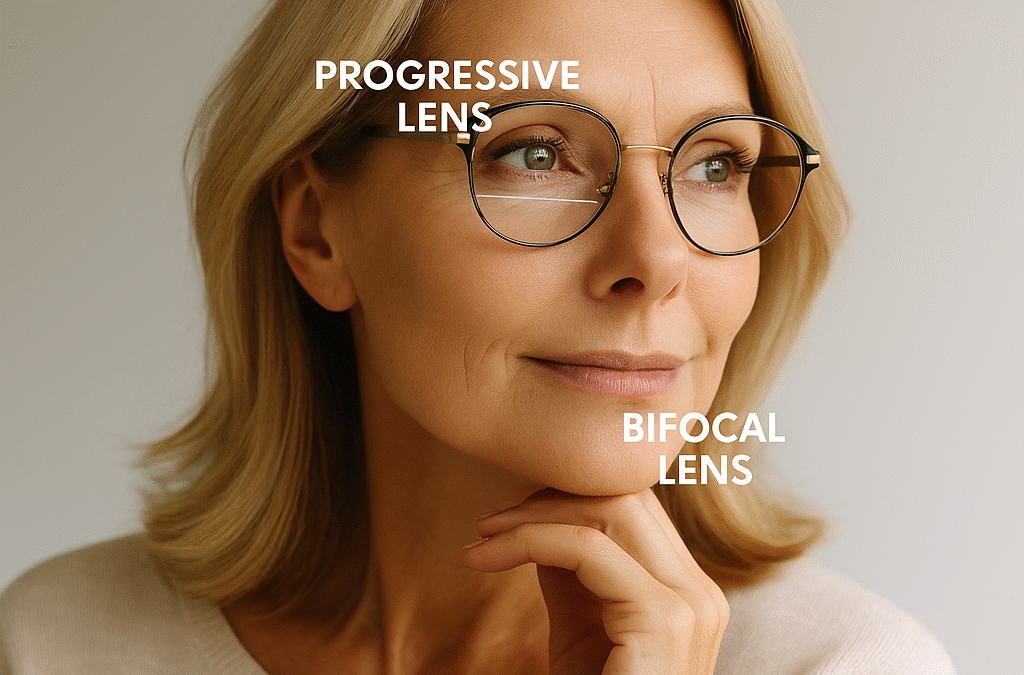
When it comes to choosing the right eyeglasses, two of the most common lens options for people who need help with both near and distance vision are progressive lenses and bifocal lenses. While both serve the purpose of correcting presbyopia (age-related near vision problems), the differences in design, appearance, and comfort can impact your choice. In this article, we’ll break down the main differences, their pros and cons, and help you decide which one may be the best fit for your lifestyle.
What Are Bifocal Lenses?
Bifocal lenses are traditional eyeglass lenses designed with two distinct sections:
These two zones are separated by a visible line across the lens. Many patients recognize bifocals instantly because of this tell-tale dividing line.
Advantages of Bifocal Lenses:
Affordable compared to progressive lenses.
Easy to adapt for those used to traditional glasses.
Clear distinction between near and far vision.
Drawbacks:
Noticeable line on the lens, which some people find unattractive.
No correction for intermediate vision (like computer use).
Sudden “image jump” when switching focus from distance to near.
What Are Progressive Lenses?
Progressive lenses, often called “no-line bifocals,” are advanced lenses that provide a smooth transition between multiple vision zones:
Top portion: Distance vision.
Middle portion: Intermediate vision (perfect for computer work).
Bottom portion: Near vision for reading.
Unlike bifocals, progressives have no visible line, making them look like regular single-vision lenses.
Advantages of Progressive Lenses:
Aesthetic appeal—no visible dividing line.
Provide distance, intermediate, and near vision in one lens.
Smooth, natural transition between vision zones.
Drawbacks:
More expensive than bifocals.
May take time to adapt due to “peripheral blur.”
Requires precise fitting for comfort.
Progressive vs. Bifocal Lenses: Key Differences
| Feature | Bifocal Lenses | Progressive Lenses |
|---|
| Appearance | Visible line dividing lens | No visible line |
| Vision Zones | Distance & near only | Distance, intermediate & near |
| Aesthetics | Noticeable aging sign | Looks like regular lenses |
| Adaptation | Easy for beginners | May take time to adjust |
| Cost | Budget-friendly | Higher investment |
| Best For | Basic near & distance needs | Active lifestyles, computer users, modern aesthetics |
Which One Should You Choose?
Your choice depends on your lifestyle and visual needs:
If you mainly need glasses for reading and distance with no concern for intermediate vision (like computer use), bifocals may be sufficient.
If you want a modern, all-in-one solution for driving, computer work, and reading, progressive lenses are the better option.
👉 At Parham Optical, we specialize in both progressive and bifocal lenses. Book an eye exam today and let our optometrists help you choose the right option for your lifestyle.
How to Adapt to Progressive or Bifocal Lenses
For bifocals: Simply adjust to the line—look down for reading and straight ahead for distance.
For progressives: Practice moving your head instead of your eyes when shifting focus. It typically takes 1–2 weeks to fully adjust.
Both progressive and bifocal lenses can significantly improve your vision, but they serve different lifestyles. Bifocals are a practical and budget-friendly choice, while progressives are a stylish and versatile solution for today’s busy world.
👉 Visit Parham Optical in Aurora, Newmarket, Richmond Hill, or King City to find the perfect pair of lenses for your vision needs. Call us today to book your appointment!
Frequently Asked Questions (FAQs)
Q1: Are progressive lenses worth the extra cost?
Yes, for most patients who need near, intermediate, and distance correction, progressives offer better value and versatility.
Q2: Do progressive lenses cause dizziness?
Some people may feel peripheral blur during the first week, but most adapt quickly.
Q3: Can I drive with bifocal lenses?
Yes, but you may experience image jumps when switching focus. Progressives often provide smoother vision for driving.
Q4: How long does it take to get used to progressive lenses?
Typically 1–2 weeks, but some people may need up to a month.
Q5: Do progressives last longer than bifocals?
The lifespan depends on lens quality and coatings, not the type. However, progressives offer more long-term flexibility.